

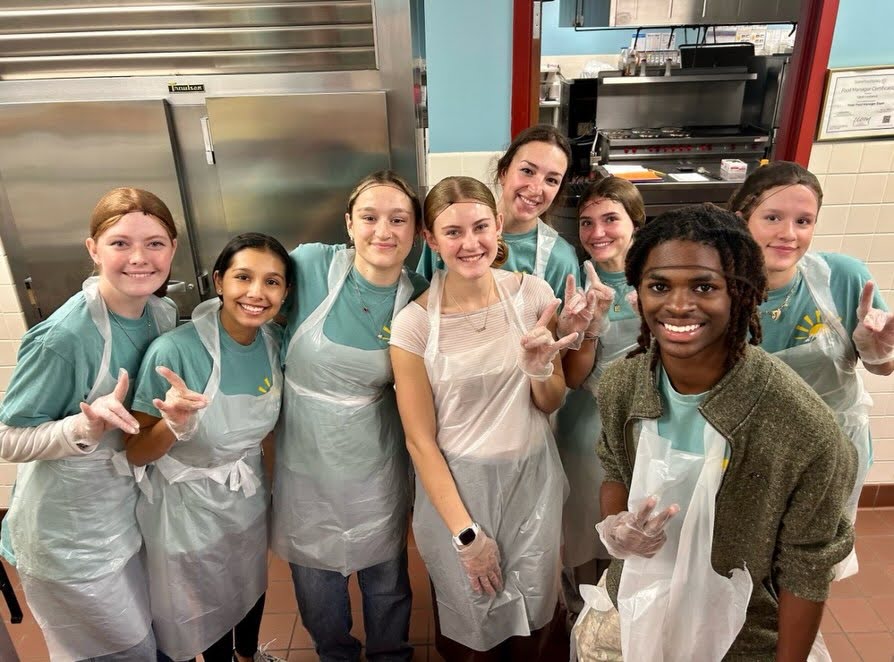
Whether it’s being a mentor to elementary and middle schoolers, visiting the Alzheimer’s home or helping out in school events, students in the PALS program are always moving about and looking for opportunities to serve the community with smiles on their faces.
PALS, or Peer Assistance Leadership and Service, is a district-wide program dedicated to being a role model for people of all ages, as well as helping out the community.
“We get to talk about and work with people from all different walks and stages of life, so that’s a joy and a challenge,” PALS teacher Jared Lippe said. “The preparation is just talking about the special needs of each age group and things we need to talk about and address.”
The PALS help out in their feeder schools in everything from field days and festivals to carnivals and even Thanksgiving lunches.
“They need a lot of volunteers for a few days to serve food, welcome families and even sit with kids whose families aren’t able to show up for the Thanksgiving feast,” Lippe said. “We always have a lot of involvement with our local schools. If anyone ever has an event or volunteer need, we spread the word and just see who is available to help.”
Students involved in PALS are assigned a specific school, and once a week, they visit their schools and spend time with their assigned kids, playing games and helping them out emotionally the best way possible.
“I bring them crafts like things to do for Thanksgiving or Halloween,” junior PAL Addison Mayo said. “My younger PAL-ee likes to color a lot, and [the] older one likes to play games. So far we’ve been really only one-on-one, so I can bond closer with them and get to know them better, but I think soon we’ll play with other classmates, especially since one of my PAL-ees has a lot of friends she wants to play with.”
The PALS also visit the Cedar Ridge Alzheimer’s Special Care Center. Mayo said she wasn’t sure if she was going to like it at first but ended up liking it a lot.
“The people there have a lot of interesting backgrounds and stories to share,” Mayo said. “It made me sad to hear some things from them, like they couldn’t remember much of their life or they missed people who passed that they were close to. One woman told me and the group that was talking to her to stay strong throughout life.”
The PALS are also assigned to complete four hours of volunteer work at the school. One of the activities Mayo decided to help out in was the 6A UIL marching band competition.
“It was cool,” Mayo said. “It was funny to see the side of the competition I don’t usually see, like the actual event side of it because I’m always in the inner workings of it behind the scenes. I led a band around, but they seemed to already know what to do, so I really didn’t have to do anything.”
The student leaders of PALS are president Marisa Kubasiak, vice president Lucy Zitter, and social officers Kiana Muck and Giana Mullen. Kubasiak said she helps facilitate the program by helping Lippe plan all of the events such as the PALS picnic and the Alzheimer’s home visit. She also guides the officers on the social media posts that go up.
“Everything that I’ve ever done in PALS has basically been a positive experience,” Kubasiak said. “I’ve learned so much about myself by helping other people. Spreading my kindness to others has also in a way spread kindness and positivity to me, and I feel like the class has just really changed me as a person. I think it’s one of the most valuable classes I’ve taken in high school.”
As a junior, Kubasiak was a mentor for middle schoolers and had to figure out the best activities to do with them.
“Something that was challenging was finding a good boundary between what’s too ‘little kid-ish’ and what is right for a middle schooler,” Kubasiak said. “They’re not elementary schoolers, and they need a little bit more mature activities, but also they’re still kids.”
Kubasiak said she was able to overcome the challenge by getting to know her PAL-ees and knowing what they like to do, as well as teaching them new skills.
“Last year, there was this guy named Nolan and he taught me how to shuffle,” Kubasiak said. “Me and my PAL-ee were playing a game a few visits later, and I was shuffling the cards the way Nolan taught me to. My PAL-ee couldn’t figure out how to shuffle them like I was.”
Kubasiak’s PAL-ee eventually figured out how to shuffle the cards.
“It took like a month,” Kubasiak said. “And then she got shuffling down, and now she’s a pro shuffler. I actually met her a month ago and she showed me her shuffling skills.”
Another challenge Kubasiak faced was learning how much of her personal life to share with her PALS.
“I’m not just gonna dump out everything to my kids,” Kubasiak said. “But I wanna make sure that it seems genuine and I build a connection, so that was definitely a challenge finding out how much of myself I should share.”
In order to join PALS, students must first sign up for PALS on their schedule. Once they have signed up, they start an enrollment process, which involves joining the Google Classroom and completing a process called “the road to travel portfolio.”
“If we have an abundance of people who signed up for PALS, there is a lottery system that they just work to see who gets in,” Lippe said. “Unfortunately, not everyone can get in because there are limited spots.”
Lippe said it’s important for students to be role models and do the work needed to be able to join PALS.
“We assert ourselves as student leaders and role models, both to the kids we’re working with and to our peers in the community in general,” Lippe said. “So in order to be and stay in PALS, you need to be a role model in all areas of your life, including grades, attendance, good behaviours and just [having] a positive reputation in the campus and in the community.”
ethan c morris-hodges • Dec 10, 2025 at 2:33 pm
great work sebastian I love pals and the thanks giving was so fun and pals is a fun class to