![Musical theatre class runs through “Footloose” during their dress rehearsal. Senior student director Mia Morneault says how much she’s enjoyed working with the cast and crew. “I am very proud of all the cast and crew who worked as hard on it as I have. A lot of people care about [this show],” Morneault said. “I have a lot of friends on the cast and on the crew, but I’ve also grown and gained friendships through the show, even as director where I may be a little more stricter than normal. And I am very grateful for everyone I’ve gotten to work with.”](https://cphswolfpack.com/wp-content/uploads/2026/05/DSC_0657-1200x800.jpg)

![Sitting in a line of artwork, senior art student Kaemon Kato’s painting titled “Right Side of History” is displayed for attendees of the district’s art showcase. Kato’s painting is a political piece inspired by a photo of elementary schoolers in the street protesting against ICE. “I think it's also symbolic because they're surrounded by snow, which can represent ICE, and they are still marching,” Kato said. “[The kids] are not stopping until equality or justice is served, which I think is really important to represent and show.” Photo by John Pinion](https://cphswolfpack.com/wp-content/uploads/2026/04/Screenshot-2026-03-26-114740.png)


![Broadcast, yearbook and newspaper combined for 66 Interscholastic League Press Conference awards this year. Yearbook won 43, newspaper won 14 and broadcast took home nine. “I think [the ILPC awards] are a great way to give the kids some acknowledgement for all of their hard work,” newspaper and yearbook adviser Paige Hert said. “They typically spend the year covering everyone else’s big moments, so it’s really cool for them to be celebrated so many times and in so many different ways.”](https://cphswolfpack.com/wp-content/uploads/2025/05/edited-ILPC.jpg)


![Holding up the bi-district champions trophy, junior shortstop Hudson Cuevas cheers alongside his team. The varsity baseball team played in the bi-district round of playoffs against the Boerne Greyhounds April 30-May 2, where they won Game 1 6-4, lost Game 2 2-1 and won the last game 5-2, allowing them to advance to area. “Honestly, [my favorite] big moment that wasn't even part of my moment was Dom's grand slam,” Cuevas said. “That was a big game changer in Game 1 of round one that ultimately helped us win that game and even move on. It set the tone for the games after and has really impacted and sparked this whole playoff run.” Photo by Allie Tseng](https://cphswolfpack.com/wp-content/uploads/2026/05/allie-boerne00159-1200x800.jpg)





![After he takes the handoff, senior running back Trae Hill runs down the field in search of a first down. Hill rushed for three touchdowns in the 43-36 loss against Frisco Wakeland last Friday, but the Timberwolves were eliminated from playoff contention. “[I’m] just happy I got to experience the game with my brothers,” Hill said. “I’m going to remember how close and how enjoyable everything was with these guys. They are my brothers for life. Just waking up and grinding together, and proving the naysayers wrong [was my favorite part].”
Photo by Kyra Cox](https://cphswolfpack.com/wp-content/uploads/2025/11/trae-hill-wakeland.jpg)
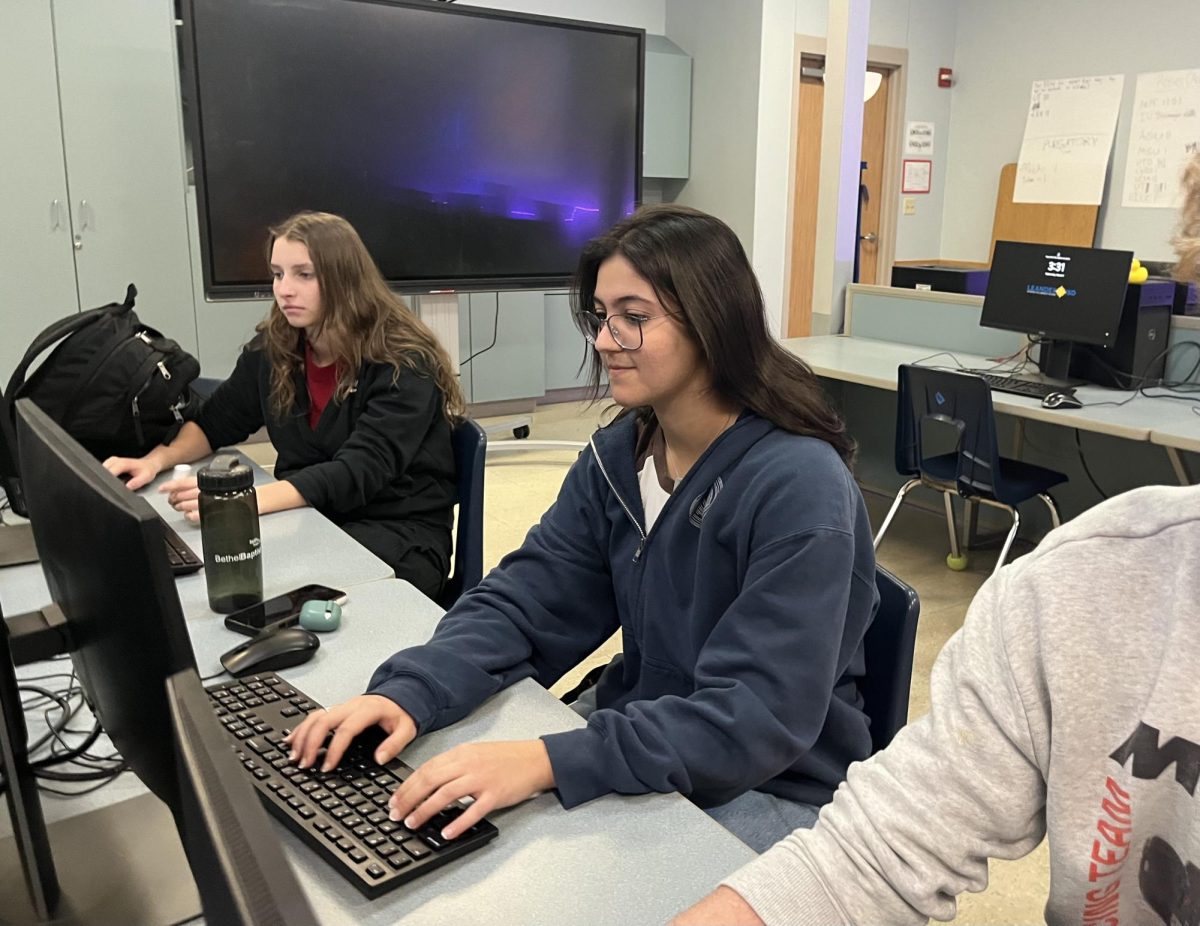
The hum of computers, a soft buzz punctuated by the occasional click of a mouse, fills the computer lab as students sit at their desks, hunched over their screens typing away. Some students scroll through documents, reports and other bits of information, piecing together the details of a cybersecurity incident. Sifting through the irrelevant data and honing in on the crucial clues, eventually, the root of the issue reveals itself. This type of multi-day assignment, requiring students to act as a Department of Homeland Security group, is one part of being in the cybersecurity class.
Foundations of Cybersecurity, taught by computer science and cybersecurity teacher Stacy Roberts, follows a government pre-curriculum for cybersecurity called cyber.org, focused on teaching students how cybersecurity is implemented, its dangers and general internet safety. This is the first year Cedar Park has offered the course, and its third year in the district.
“There’s a large amount of current events information that gets shared in here, because the students are paying attention and they’re looking at their surroundings,” Roberts said. “We laugh, joke and have a great time with that too, but the discussions around that are very real.”
The class assignments include step-by-step labs using a program called Cyber Range. This simulated platform allows students to switch between different machines that perform automatic tasks, such as Kali Linux, a software with various tools for information security tasks, without needing to use multiple different computers. They also do in depth discussions over the topics.
“It definitely took a moment to get used to Linux and just how it works, but it’s been pretty fun,” junior Dennis Ortinski said. “In general, using the tools and seeing what you can find out with them is always interesting.”
The class’ projects focus on various aspects of cybersecurity. This includes exploration of real-world ethical dilemmas such as debates over privacy versus security and pretending to be Department of Homeland Security groups who uncover more information about a given incident over time. It also includes DDOS (Distributed Denial-of-Service) attack simulations where students overload each other’s computers to slow them down and more.
“One of the most interesting projects I’ve worked on in this class was the ethics unit in cybersecurity,” junior Stephanie Manoel said. “It was really eye-opening to think about how cybersecurity professionals have to balance technical skills with ethical decision-making and how few laws there really are regarding technology.”
In the future, Roberts said the intention is to run the entire pathway for the course, offering more advanced cybersecurity tracks. The curriculum is based on settled events, typically 2019 or older.
“We jokingly say that there’s a lot of ‘whackamole’ where new things happen and they have to find new things,” Roberts said. “If we go into an event that is more current, then we’re treading on unknown waters, and they’re not going to do that. You want to be very careful about what you say and who you say did it.”
To take the class, students must have completed either Computer Science I or Computer Science Principles. According to Ortinski, he wanted to take the class because of family background in cybersecurity.
“The class definitely taught me that the field of cybersecurity is a lot wider than I expected it to be,” Ortinski said. “I always thought it was just breaking websites and stealing data or information or scamming people with fake links. I never really expected it to go as deep as it does.”
This is a new course for Roberts this year, but in her time at Cedar Park, she has had to learn to teach up to three new courses in one year. She used to work in the Navy, where she also learned some of the skills she is now teaching in this course.
“I was that student that enjoyed learning and got bored and would try new things, so it works for me to put that little bit of challenge in there,” Roberts said. “I am learning about things I knew how to use, but I didn’t really know why. The kids are excited too, which makes things interesting.”