

![Musical theatre class runs through “Footloose” during their dress rehearsal. Senior student director Mia Morneault says how much she’s enjoyed working with the cast and crew. “I am very proud of all the cast and crew who worked as hard on it as I have. A lot of people care about [this show],” Morneault said. “I have a lot of friends on the cast and on the crew, but I’ve also grown and gained friendships through the show, even as director where I may be a little more stricter than normal. And I am very grateful for everyone I’ve gotten to work with.”](https://cphswolfpack.com/wp-content/uploads/2026/05/DSC_0657-1200x800.jpg)

![Sitting in a line of artwork, senior art student Kaemon Kato’s painting titled “Right Side of History” is displayed for attendees of the district’s art showcase. Kato’s painting is a political piece inspired by a photo of elementary schoolers in the street protesting against ICE. “I think it's also symbolic because they're surrounded by snow, which can represent ICE, and they are still marching,” Kato said. “[The kids] are not stopping until equality or justice is served, which I think is really important to represent and show.” Photo by John Pinion](https://cphswolfpack.com/wp-content/uploads/2026/04/Screenshot-2026-03-26-114740.png)



![Broadcast, yearbook and newspaper combined for 66 Interscholastic League Press Conference awards this year. Yearbook won 43, newspaper won 14 and broadcast took home nine. “I think [the ILPC awards] are a great way to give the kids some acknowledgement for all of their hard work,” newspaper and yearbook adviser Paige Hert said. “They typically spend the year covering everyone else’s big moments, so it’s really cool for them to be celebrated so many times and in so many different ways.”](https://cphswolfpack.com/wp-content/uploads/2025/05/edited-ILPC.jpg)


![Holding up the bi-district champions trophy, junior shortstop Hudson Cuevas cheers alongside his team. The varsity baseball team played in the bi-district round of playoffs against the Boerne Greyhounds April 30-May 2, where they won Game 1 6-4, lost Game 2 2-1 and won the last game 5-2, allowing them to advance to area. “Honestly, [my favorite] big moment that wasn't even part of my moment was Dom's grand slam,” Cuevas said. “That was a big game changer in Game 1 of round one that ultimately helped us win that game and even move on. It set the tone for the games after and has really impacted and sparked this whole playoff run.” Photo by Allie Tseng](https://cphswolfpack.com/wp-content/uploads/2026/05/allie-boerne00159-1200x800.jpg)





![After he takes the handoff, senior running back Trae Hill runs down the field in search of a first down. Hill rushed for three touchdowns in the 43-36 loss against Frisco Wakeland last Friday, but the Timberwolves were eliminated from playoff contention. “[I’m] just happy I got to experience the game with my brothers,” Hill said. “I’m going to remember how close and how enjoyable everything was with these guys. They are my brothers for life. Just waking up and grinding together, and proving the naysayers wrong [was my favorite part].”
Photo by Kyra Cox](https://cphswolfpack.com/wp-content/uploads/2025/11/trae-hill-wakeland.jpg)
After six years of no state funding increases for Texas public schools, unfunded state mandates and inflation rates, the district is facing a $21.2 million deficit as they plan the 2025-26 school year budget. To address the deficit, the district is making adjustments to staffing numbers, which account for 87% of the 2024-25 budget. By modifying staff numbers at the central office and campus level, the district aims to close the budget gap to around $17 million, which is $4 million above the board-approved deficit parameter.
“The district has been a great steward of taxpayer dollars over many years,” Superintendent Bruce Gearing, Ed.D. said in an interview on the Wolfcast. “[But], in our current year budget, we’re running a large deficit, much larger than we’d like. We cannot continue to spend out of our savings account year after year, and remain financially solvent. These reductions are absolutely necessary as we go forward in order to make sure that we remain financially stable for the long term.”
On Feb. 4, school principals received outlines from the district regarding their staffing allocations for the 2025-26 school year. Across all high schools, 80.5 positions will be impacted and the IB Programme will be phased out of school curriculum by the end of the 2025-26 school year.
“We need our campuses to be able to understand what their staffing allocations are, so that they can adequately plan through the spring for next year,” Gearing said. “The hardest part about all of this is that we are a human capacity organization. The strength of Leander ISD is the people and the relationships that we have between us. When you’re having to reduce the number of people that you have in the organization, it’s very personal. This is the real lives of real people that have been affected.”
When a staffing position is labeled as surplus, there are too many staff members than what the school can keep on the next year’s budget. Teachers who are surplused will go back into the transfer portal for the district at the end of the school year and begin interviewing for other positions.
AP Psychology and economics teacher Lauren Livingston moved to the school after being surplused from Vandegrift last year as the library media specialist. This year, her teaching position was marked as a staff surplus again.
“As of right now, there is not the budget to keep me or my position on this campus,” Livingston said. “I don’t know if it’s ironic, but this is my second year being surplus. At this point, I will be happy with whatever is open [on the transfer portal]. It’s not like everybody is going to have a guaranteed spot. We don’t really know what’s going to happen, because this is the biggest surplus that we’ve had in a few years. It’s a little intimidating, but I’m hoping for the best.”
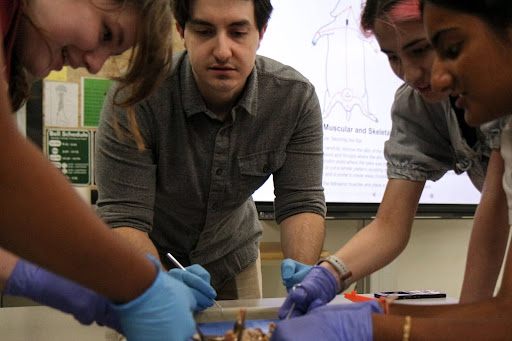
With the reduction in teaching positions at school, the overall student-educator ratio is expected to increase from 20:1 to 22:1 next year. Anatomy and Physiology teacher Tyler Terry, who also teaches Medical Microbiology, Practicum in Health Science: Pharmacy Technician and is the HOSA sponsor, expects class sizes to increase and impact the school environment.
“It’s going to be a real challenge to try to reduce the number of teachers and squeeze the same number of students into fewer classes,” Terry said. “For classes with a strict capacity limit, that presents a different kind of challenge. I know the district’s goal is to minimize impact on student’s opportunities, so I really hope we don’t start losing programs due to this. Classroom management is going to become more difficult for teachers, and students are probably going to feel even more cramped. It’s really hard to give individual one-on-one attention to every student who needs it when the class gets that big.”
To minimize the effects of crowded classrooms, the district is working with high schools to train administrations on how to efficiently conduct master schedules, while continuing to watch class sizes.
“I feel like it’s very easy for people that are not involved with these really hard choices to say, yes, there is always a better solution,” Livingston said. “I’m not in the position that our district administration is in where I have to make these hard choices. I’m sure that there are better ways. I’m sure that there are worse ways. But as of right now, I think they are doing the best they can with the information that they have.”
According to Gearing, the district is monitoring the work being done in the state legislature regarding school vouchers, which would divert state funding for public schools to private school parents, helping them pay for private school tuition.
“If you use public funds to pay for private schools, that’s not privately funded education anymore,” Terry said. “That’s publicly funded education, just without transparency and accountability. But private isn’t necessarily guaranteed to be better than public. School vouchers are a super efficient way to take money away from the people who need it the most—those that rely on public education—and give it to those who need it the least—the families who send their kids to private school. It is corrupt. To put it lightly, it disappoints me.”
Gearing does not expect the school board to approve a 2025-26 school year budget until late June. Until then, staff members, students, parents and community members are encouraged to stay informed on the proposed budget and state legislature. Information is available on Leander ISD’s news website.
“This process has been a very collaborative one with our school and district leadership,” Gearing said. “Our priority is the safety and security of all of our students and staff. Our parents send their most precious resource to us every morning, and our job is to make sure that we return them again every evening, a little better than how we got them. My hope is in our future generations, in the students who are sitting in our public school classrooms right now. There are some big challenges coming our way, and those challenges will likely get bigger as we go forward, but the job that we do, helping our students prepare themselves for that future, whatever that holds, is what is becoming critical.”