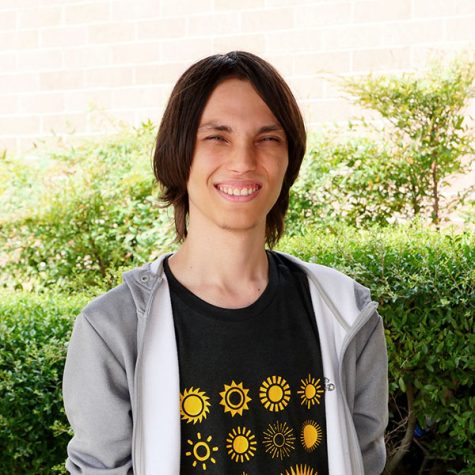
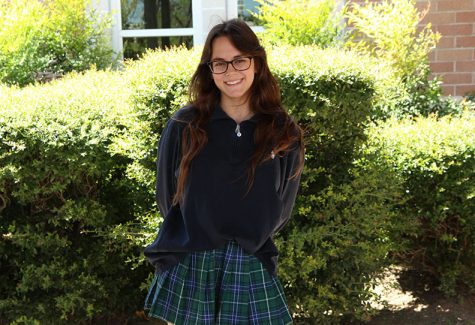
![Musical theatre class runs through “Footloose” during their dress rehearsal. Senior student director Mia Morneault says how much she’s enjoyed working with the cast and crew. “I am very proud of all the cast and crew who worked as hard on it as I have. A lot of people care about [this show],” Morneault said. “I have a lot of friends on the cast and on the crew, but I’ve also grown and gained friendships through the show, even as director where I may be a little more stricter than normal. And I am very grateful for everyone I’ve gotten to work with.”](https://cphswolfpack.com/wp-content/uploads/2026/05/DSC_0657-1200x800.jpg)

![Sitting in a line of artwork, senior art student Kaemon Kato’s painting titled “Right Side of History” is displayed for attendees of the district’s art showcase. Kato’s painting is a political piece inspired by a photo of elementary schoolers in the street protesting against ICE. “I think it's also symbolic because they're surrounded by snow, which can represent ICE, and they are still marching,” Kato said. “[The kids] are not stopping until equality or justice is served, which I think is really important to represent and show.” Photo by John Pinion](https://cphswolfpack.com/wp-content/uploads/2026/04/Screenshot-2026-03-26-114740.png)



![Broadcast, yearbook and newspaper combined for 66 Interscholastic League Press Conference awards this year. Yearbook won 43, newspaper won 14 and broadcast took home nine. “I think [the ILPC awards] are a great way to give the kids some acknowledgement for all of their hard work,” newspaper and yearbook adviser Paige Hert said. “They typically spend the year covering everyone else’s big moments, so it’s really cool for them to be celebrated so many times and in so many different ways.”](https://cphswolfpack.com/wp-content/uploads/2025/05/edited-ILPC.jpg)


![Holding up the bi-district champions trophy, junior shortstop Hudson Cuevas cheers alongside his team. The varsity baseball team played in the bi-district round of playoffs against the Boerne Greyhounds April 30-May 2, where they won Game 1 6-4, lost Game 2 2-1 and won the last game 5-2, allowing them to advance to area. “Honestly, [my favorite] big moment that wasn't even part of my moment was Dom's grand slam,” Cuevas said. “That was a big game changer in Game 1 of round one that ultimately helped us win that game and even move on. It set the tone for the games after and has really impacted and sparked this whole playoff run.” Photo by Allie Tseng](https://cphswolfpack.com/wp-content/uploads/2026/05/allie-boerne00159-1200x800.jpg)





![After he takes the handoff, senior running back Trae Hill runs down the field in search of a first down. Hill rushed for three touchdowns in the 43-36 loss against Frisco Wakeland last Friday, but the Timberwolves were eliminated from playoff contention. “[I’m] just happy I got to experience the game with my brothers,” Hill said. “I’m going to remember how close and how enjoyable everything was with these guys. They are my brothers for life. Just waking up and grinding together, and proving the naysayers wrong [was my favorite part].”
Photo by Kyra Cox](https://cphswolfpack.com/wp-content/uploads/2025/11/trae-hill-wakeland.jpg)


Prep, Prep and More Prep
PSAT Team Prepares for the Next Test
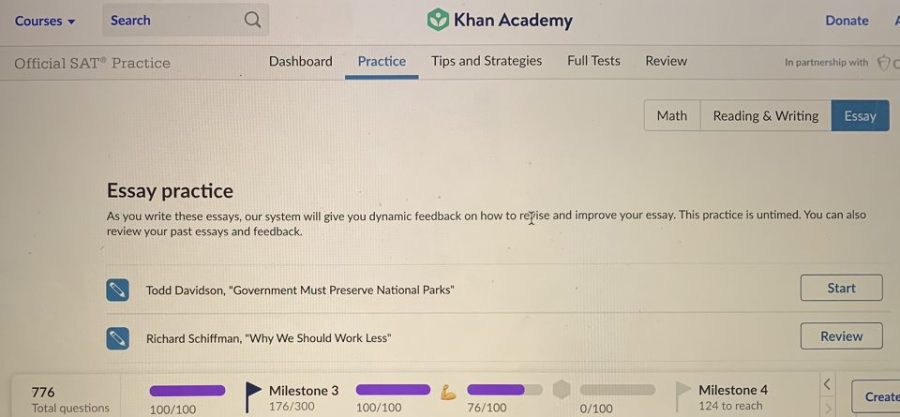
The PSAT Team uses sites like Khan Academy for study material. This year, they used it to study for this year’s PSAT, and will do the same for the SAT. “The most useful resource has definitely been Khan Academy,” junior PSAT team student, Tristan Hernandez, said. “It lets us work out practice problems that are similar to the actual PSAT.”
November 7, 2020
On Oct. 29, 10th and 11th graders took the NMSQT, the version of the PSAT that is used to determine which sophomores and juniors are eligible to enter the National Merit Scholarship program. Students were either given four hours to complete the test or the option to stay home for asynchronous learning if they opted out.
For those who took it, such a short period of time could either fly by in an instant or seemingly drag on for eternity. What is true for most students is that after the PSAT was done, they could go home knowing that they just completed one of the biggest tests of the year, lifting a huge weight off of their shoulders. However, according to math teacher Mary Beth Battles and English II and AP Capstone Research teacher Lauren Madrid, who are both part of the PSAT Team, this is only the beginning.
“After the PSAT, math starts focusing on the other topics of the SAT, ” Battles said. “These are some difficult concepts that do not appear on the PSAT. We also compare the SAT to the ACT so students can see how they differ, as well as practice ACT tests.”
The prep work the PSAT team, an elective for LISD juniors, offers covers all the ground needed to succeed on the PSAT, SAT and other standardized tests. Khan Academy is a frequently used website for the class as they are partnered with College Board, the organization that administers the PSAT. Their lessons can range from questions about within-sentence punctuation to the correct way to analyze a scatter plot and how to factor polynomials. The website’s wide array of videos can be a major help to learn the necessary skills on the test.
“The most useful resource has definitely been Khan Academy,” junior PSAT team student Tristan Hernandez said. “It lets us work out practice problems that are similar to the actual PSAT.”
On Nov. 4, nearly one week after the PSAT was taken, the group covered what SAT essays should look like and specific do’s and don’ts when structuring the main points of the essay. Two articles, both from Khan Academy, were given for the students to discuss. One of them was a glossary of terms, including diction, logos, pathos, ethos, syntax and parallel sentence structure. All of these are used in stories and articles featured on the SAT, and it’s up to students to notice and note them in their essays. On another day, the group plans to tackle math typically seen in the 10th and 11th grades, like geometry, trigonometry and complex numbers.
“Usually I create a Peardeck for students to follow and we work on procedures for solving math problems quickly,” Battles said. “Talking about math is an extremely important method for seeing and understanding it better. Being virtual made this very difficult and even breakout groups didn’t seem to help, so we mostly worked as a class and individually.”
The students in PSAT team was given an SAT at the beginning of the year in order to gauge what topics needed to be focused on. Each section of the PSAT – reading, writing and language and math with and without calculators – was broken down into the hardest question types, and when students started getting them right, timed sections were given. There is almost no homework in the course, but students are expected to practice individually.
“I liked learning the topics with the teacher and then practicing them by myself because it made sure I fully understood the section that we were learning,” Hernandez said. “Even though, during presentations, they called on us randomly to give answers, it made me pay attention and helped me learn the topics.”
In the PSAT Team, it is the student’s responsibility to follow through on practicing. The actual work is not what the class gives, but how motivated and willing to practice students are in order to receive a good score on the PSAT.
“Mrs. Madrid and I can guide them, but students will only get out what they put in,” Battles said. “Under the awkward circumstances of being virtual, I think the majority of our team did very well and participated in carrying out the day-to-day procedures. If they truly want to be a National Merit Scholar, they have to be willing to work like one.”