![Musical theatre class runs through “Footloose” during their dress rehearsal. Senior student director Mia Morneault says how much she’s enjoyed working with the cast and crew. “I am very proud of all the cast and crew who worked as hard on it as I have. A lot of people care about [this show],” Morneault said. “I have a lot of friends on the cast and on the crew, but I’ve also grown and gained friendships through the show, even as director where I may be a little more stricter than normal. And I am very grateful for everyone I’ve gotten to work with.”](https://cphswolfpack.com/wp-content/uploads/2026/05/DSC_0657-1200x800.jpg)

![Sitting in a line of artwork, senior art student Kaemon Kato’s painting titled “Right Side of History” is displayed for attendees of the district’s art showcase. Kato’s painting is a political piece inspired by a photo of elementary schoolers in the street protesting against ICE. “I think it's also symbolic because they're surrounded by snow, which can represent ICE, and they are still marching,” Kato said. “[The kids] are not stopping until equality or justice is served, which I think is really important to represent and show.” Photo by John Pinion](https://cphswolfpack.com/wp-content/uploads/2026/04/Screenshot-2026-03-26-114740.png)



![Broadcast, yearbook and newspaper combined for 66 Interscholastic League Press Conference awards this year. Yearbook won 43, newspaper won 14 and broadcast took home nine. “I think [the ILPC awards] are a great way to give the kids some acknowledgement for all of their hard work,” newspaper and yearbook adviser Paige Hert said. “They typically spend the year covering everyone else’s big moments, so it’s really cool for them to be celebrated so many times and in so many different ways.”](https://cphswolfpack.com/wp-content/uploads/2025/05/edited-ILPC.jpg)


![Holding up the bi-district champions trophy, junior shortstop Hudson Cuevas cheers alongside his team. The varsity baseball team played in the bi-district round of playoffs against the Boerne Greyhounds April 30-May 2, where they won Game 1 6-4, lost Game 2 2-1 and won the last game 5-2, allowing them to advance to area. “Honestly, [my favorite] big moment that wasn't even part of my moment was Dom's grand slam,” Cuevas said. “That was a big game changer in Game 1 of round one that ultimately helped us win that game and even move on. It set the tone for the games after and has really impacted and sparked this whole playoff run.” Photo by Allie Tseng](https://cphswolfpack.com/wp-content/uploads/2026/05/allie-boerne00159-1200x800.jpg)





![After he takes the handoff, senior running back Trae Hill runs down the field in search of a first down. Hill rushed for three touchdowns in the 43-36 loss against Frisco Wakeland last Friday, but the Timberwolves were eliminated from playoff contention. “[I’m] just happy I got to experience the game with my brothers,” Hill said. “I’m going to remember how close and how enjoyable everything was with these guys. They are my brothers for life. Just waking up and grinding together, and proving the naysayers wrong [was my favorite part].”
Photo by Kyra Cox](https://cphswolfpack.com/wp-content/uploads/2025/11/trae-hill-wakeland.jpg)


The Case for Railway
Why Cars Aren’t Going To Cut It
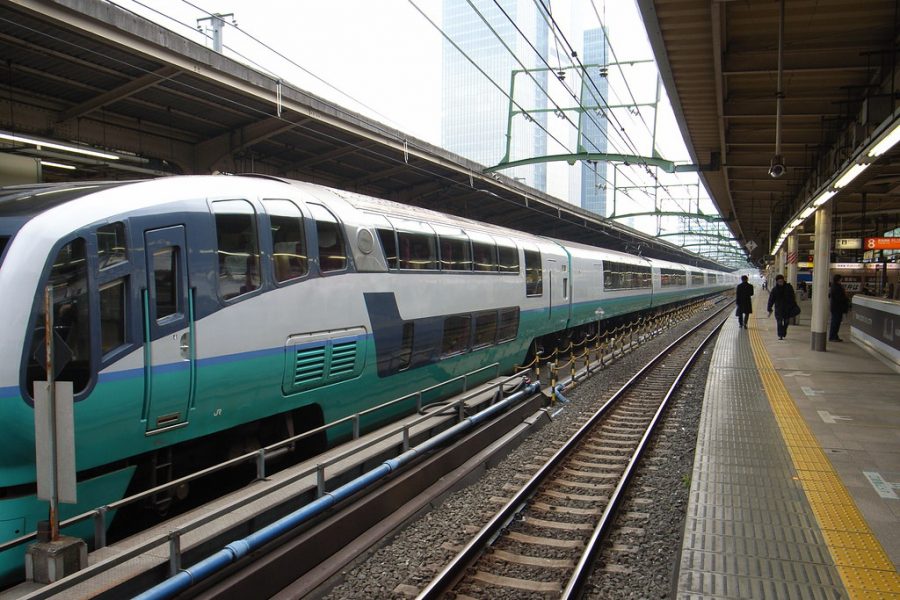
Photo by Koji Haruna on Creative Commons
Trains are the way to ensure a cleaner, more efficient transportation system for the future.
April 14, 2021
On March 31, President Joe Biden announced a $2 trillion infrastructure plan that included $165 billion allocated towards modernizing public transportation and expanding American passenger and freight networks. The change is expected to decrease congestion, control pollution and bring much-needed economic investment to American cities located next to the rail.
The plan drew a large amount of discussion, from Republican lawmakers in Washington D.C. who are wary of the scope to advocates of rail who say it is a crucial upgrade to the country’s lagging infrastructure. However, when an impartial view is used to analyze the pros and cons, the case is clear that improving rail transportation will only bring benefits to the productivity and environment of the entire nation. Here are some reasons why.
Trains Have a Smaller Carbon Footprint Than Cars
Transportation is an undeniable hurdle to cross as the fight against climate change becomes more and more urgent. According to Our World in Data, one-fifth of all CO2 emissions come from it, and as higher populations create demand for transportation it will cause a large increase in these statistics. With that being said, when the data from the same resource is broken down, it is seen that a disproportionate 74.5% of CO2 emissions come from road vehicles like cars, trucks and buses. In comparison, rail makes up 1%, less than even aviation and shipping which come at 11.6% and 10.6% respectively.
One retort for this point is that trains do not exist in as high a quantity as road vehicles, so of course they would represent a smaller percentage. After all, in 2018 Amtrak served around 31.7 million passengers while in 2015, it was seen that more than 220,000 vehicles drove in I-35 everyday, which means over 80 million people a year. But, according to The Conversation, passenger rail is actually three times more efficient than a car. Even if electric cars were added to the picture, an electric train would still be more efficient and cause less of an adverse effect on global warming.
Highways are Flawed
Most high schoolers are in the process getting a driver’s license. Here’s an image that will resonate with you all very soon: it’s about 90 degrees in Austin in the summertime, and you’re driving on I-35. It’s hot, the sun is glaring through the windshield and air conditioning can only do so much to stop the beads of sweat rolling down your face and back. When you’ve finally had enough of the weather, 20 more minutes are added to the experience by a familiar struggle: traffic jams.
Congestion is an infamously frequent issue encountered on I-35. But similar problems are found from the East to West Coast, from NYC to Los Angeles, and all big cities in between. Proposed solutions often include increasing the number of lanes. However, according to Wired, this will only provide more demand as cars pour in and cause more congestion. From taxing congested parts of the highway to encouraging carpooling, most fixes brought forward are paper-thin bandages that fail to or inadequately address the deeper issue of demand: no matter what, the option most Americans have access to are cars, and as long as that remains the case, they will congest the highway.
It Supports the Economy of Large and Small Cities Alike
It works in both directions: when large cities are provided with a steady source of workers, it supports their industries and thus their economy. When small cities are connected to these larger cities, it means their pool of skilled and talented workers now have an easy route of access to these large industries, bringing back income and population growth to them as well.
In cities like New York City, most connections to external labor are already through public transit. As one of the richest megacities in the world, 82% of their out-of-county workers in the borough of Manhattan use public transit, and 50% of commuters use the subway.
So, what if the whole of America was connected like this? That is what Amtrak has proposed. If this railway was implemented, people could now travel between swaths of the Pacific Northwest, California, the South, Southwest, Midwest, Northeast and Mid-Atlantic states with ease. Imagine the benefit it would bring to implement a nationwide system similar to the one that connects NYC.
Investment into railways would likely help the public transport system as a whole. Transportation is an essential service for everyone, and if the trip to your high school was provided by a high-speed train that also carried workers and students going to Austin, Leander, or Round Rock, it would relieve the burden on schools who pay for buses and the parents that drop you off.