![Musical theatre class runs through “Footloose” during their dress rehearsal. Senior student director Mia Morneault says how much she’s enjoyed working with the cast and crew. “I am very proud of all the cast and crew who worked as hard on it as I have. A lot of people care about [this show],” Morneault said. “I have a lot of friends on the cast and on the crew, but I’ve also grown and gained friendships through the show, even as director where I may be a little more stricter than normal. And I am very grateful for everyone I’ve gotten to work with.”](https://cphswolfpack.com/wp-content/uploads/2026/05/DSC_0657-1200x800.jpg)

![Sitting in a line of artwork, senior art student Kaemon Kato’s painting titled “Right Side of History” is displayed for attendees of the district’s art showcase. Kato’s painting is a political piece inspired by a photo of elementary schoolers in the street protesting against ICE. “I think it's also symbolic because they're surrounded by snow, which can represent ICE, and they are still marching,” Kato said. “[The kids] are not stopping until equality or justice is served, which I think is really important to represent and show.” Photo by John Pinion](https://cphswolfpack.com/wp-content/uploads/2026/04/Screenshot-2026-03-26-114740.png)


![Broadcast, yearbook and newspaper combined for 66 Interscholastic League Press Conference awards this year. Yearbook won 43, newspaper won 14 and broadcast took home nine. “I think [the ILPC awards] are a great way to give the kids some acknowledgement for all of their hard work,” newspaper and yearbook adviser Paige Hert said. “They typically spend the year covering everyone else’s big moments, so it’s really cool for them to be celebrated so many times and in so many different ways.”](https://cphswolfpack.com/wp-content/uploads/2025/05/edited-ILPC.jpg)


![Holding up the bi-district champions trophy, junior shortstop Hudson Cuevas cheers alongside his team. The varsity baseball team played in the bi-district round of playoffs against the Boerne Greyhounds April 30-May 2, where they won Game 1 6-4, lost Game 2 2-1 and won the last game 5-2, allowing them to advance to area. “Honestly, [my favorite] big moment that wasn't even part of my moment was Dom's grand slam,” Cuevas said. “That was a big game changer in Game 1 of round one that ultimately helped us win that game and even move on. It set the tone for the games after and has really impacted and sparked this whole playoff run.” Photo by Allie Tseng](https://cphswolfpack.com/wp-content/uploads/2026/05/allie-boerne00159-1200x800.jpg)




![After he takes the handoff, senior running back Trae Hill runs down the field in search of a first down. Hill rushed for three touchdowns in the 43-36 loss against Frisco Wakeland last Friday, but the Timberwolves were eliminated from playoff contention. “[I’m] just happy I got to experience the game with my brothers,” Hill said. “I’m going to remember how close and how enjoyable everything was with these guys. They are my brothers for life. Just waking up and grinding together, and proving the naysayers wrong [was my favorite part].”
Photo by Kyra Cox](https://cphswolfpack.com/wp-content/uploads/2025/11/trae-hill-wakeland.jpg)
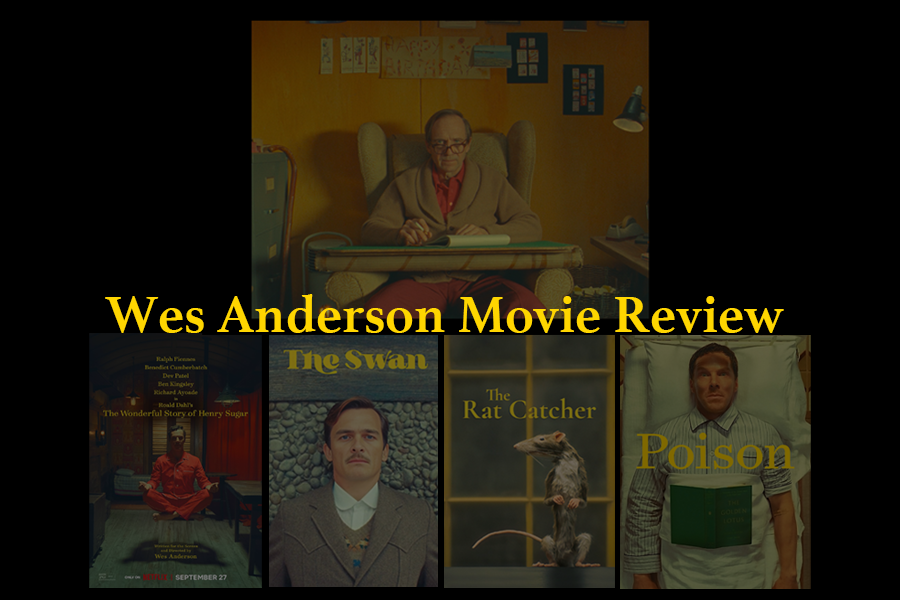
For the second time this year, filmmaker Wes Anderson has released a project. Partnering with Netflix, he released four movie adaptations of the beloved stories, “The Wonderful Story of Henry Sugar,” “The Swan,” “Poison” and “The Rat Catcher” written by Roald Dahl. “The Wonderful Story of Henry Sugar” is the longest film, at around 40 minutes, but the rest do not exceed 17 minutes. Each film had a small cast, rotating the same six actors, with some playing multiple characters in one short. A slightly more unique spin, if you can even get more unique than Anderson as his natural self, is that each of these shorts were filmed almost as though it were a theater performance with moving sets, props (or lack thereof) and people, without characters handling the set and props. These stories were hilarious and entertaining, while also being very artistically charming, leaving me wanting more yet perfectly satisfied.
Born in 1916 and passed away in 1990, Roald Dahl is a British writer who was famous for his children’s books. Some of his popular works include “Charlie and the Chocolate Factory,” “Matilda,” “James and the Giant Peach” and many others. Having sold over 300 million copies of his stories worldwide, movie adaptations are often made from his stories.
The first film to be released was “The Wonderful Story of Henry Sugar,” which just so happens to be my favorite one out of all of them. Preceding this adaptation, Anderson also directed “The Fantastic Mr. Fox” in 2009. In an interview with the New York Times, Anderson talks about how he’s been wanting to make this adaptation for a while, but never knew how to do so properly saying, “The way he tells the story is part of what I like about it.” The plot is told through a story inside of a story inside of a story: being read to the audience by Roald Dahl (played by Ralph Fiennes) and the plot following Henry Sugar (played by Benedict Cumberbatch), an extremely wealthy man, who finds a book that teaches him to see through objects. As with all of his films, the set was particularly striking. Without the distinct difference in lighting and setting of the scenery, following the storylines would have proved to be particularly difficult. Not only is it technically impressive, but the story itself is captivating. The growth in Sugar’s character is remarkable, from starting as an impossibly rich, ignorant and arrogant gambler to being a selfless person with no desire for material riches.
Released the day after the first short was “The Swan.” This one was unlike most of Anderson’s films, being more dull in color, and was a very sad, yet beautiful portrayal of the indomitable human spirit. The story follows a bright young boy who is getting bullied by two boys armed with a gun. The bullies are out shooting birds, while the boy is there bird watching, already symbolizing the vast difference between the boys. He knows that there is nothing he can do against them, but eventually he realizes that he is above his bullies in every way. The theatrical approach to the directing is especially notable in this short. The narrator speaks as the child acts out what the narrator says, with a prop occasionally being passed to him. Although I was a bit thrown off by the darker themes, I truly think the artistry in the story telling and overall message was incredibly touching, making this one my second favorite.
The third film was “The Rat Catcher.” This one was my least favorite, but I still commend it for a multitude of reasons. A garage owner has a rat problem, so he hires a rat expert to eradicate them. The owner and his employee watch the Rat Man and his methods, mesmerized yet also extremely uncomfortable. Most notably, there was a scene where a rat was shown through stop motion, calling back to his “Fantastic Mr. Fox” adaptation, as well as Anderson’s exceptionally recognizable style. Additionally, I favored the acting. There were only three actors, with Ralph Fiennes playing both Roald Dahl and the Rat Man. Some might find the small cast limiting, but I found that it pushed those actors to a different level, making a hilarious and exciting result. Artistically and technically it is really well done, but it’s lacking in the whimsiness and attitude I associate with Anderson’s work.
The final out of this short film series was “Poison.” The storyline is about a man that has a venomous snake on his stomach who is discovered by another who calls the doctor. The scene builds a lot of tension and questions, but the delivery of the lines and the story provides a blanket of humor over the otherwise stressful situation. It ends with Roald Dahl finishing his reading, smoking a cigarette, and then the screen goes black. This ending keeps the integrity of the storytelling with all of the other stories but really ties in the personalities of the writers outside of the story as well.
As the result of a child raised on reading Roald Dahl and a current lover of Wes Anderson, suffice to say I was especially excited when I heard of the arrival of this series. What has always drawn me to Anderson’s movies was the almost child-like look to them and the articulate yet simple language. Paired with another eccentric writer, the result was basically a wonderfully chaotic series of plays. I very highly recommend watching each one of these, as there’s that bright creativity in each of them, and some are more mellow than others leaving options for most to enjoy.
5/5